Incident report · sourced reporting + labeled satire
Anthropic just bulk-bought science a free Claude tab—through twenty institutional bouncers
Twenty foundations and labs get free Claude credits to hand out. Your hypothesis still needs a human who can fail it.
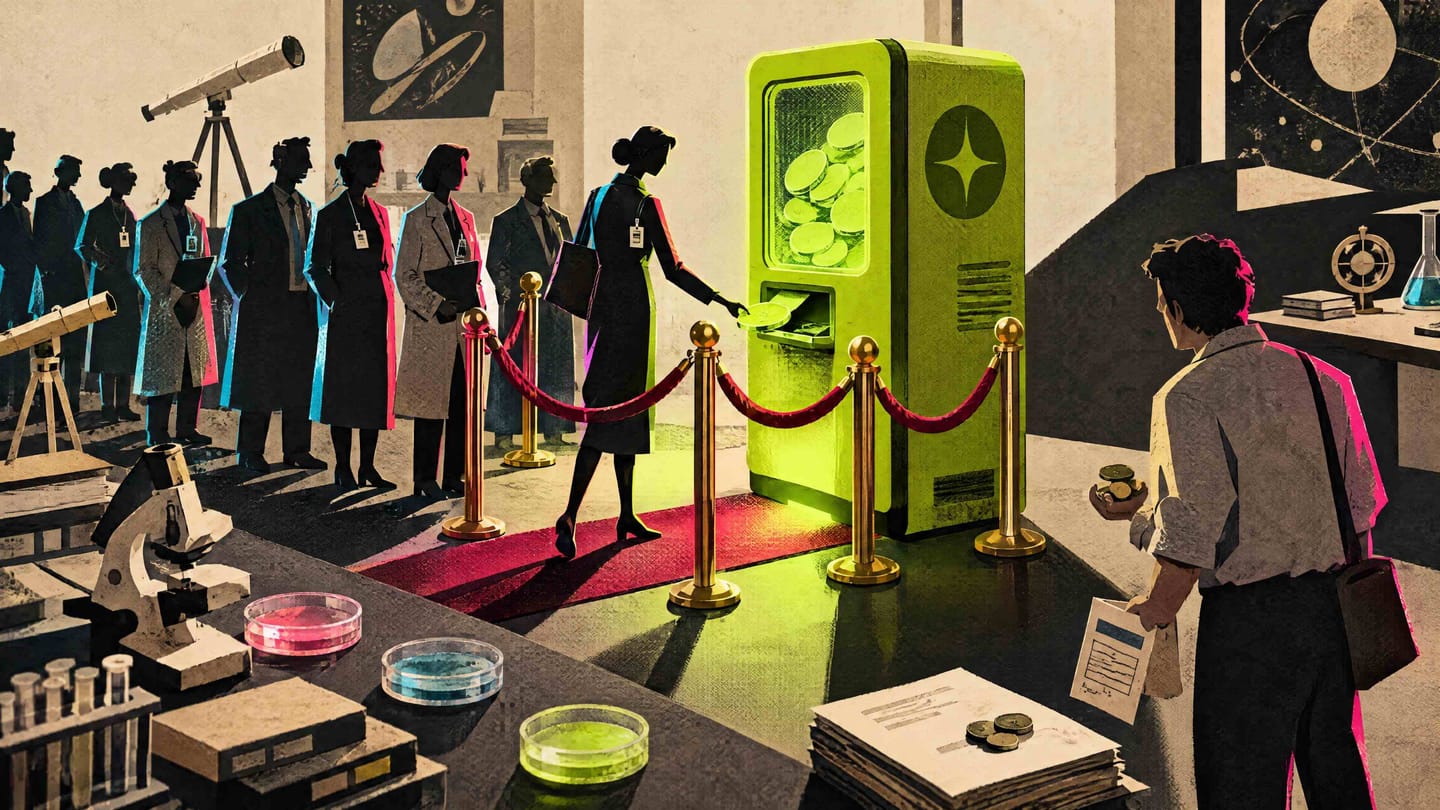
Channel 404 · Night Shift intercept
INCIDENT / FIELD REPORT / HUMAN EYES OPEN
The machine has entered the chat.
Original ANALTHROPIC visual nonsense for a serious problem. The reporting begins directly below; the neon is here to make the danger easier to spot.
FICTIONAL BROADCAST GRAPHICS NOT A PRODUCT DEMO

Technology analysis with satire // SOURCED REPORTING
Twenty foundations and labs get free Claude credits to hand out. Your hypothesis still needs a human who can fail it.
You paid for the assistant that rewrites your methods section into confident mush. Meanwhile, science just got a bulk free-token lane with a guest list.
On October 28, 2026, Anthropic said it is expanding AI for Science: free Claude credits routed through twenty foundations, institutions, and research groups worldwide. The pitch is speed—hypothesis drafts, experiment design, data analysis, write-ups. The fine print is distribution. Someone with a letterhead decides whose high-impact project gets the free meter.
FICTION — not an Anthropic memo:
From: Discovery Enablement
Subject: Your curiosity has been waitlisted
Effective immediately, approved science may burn Claude without a personal invoice. Please bring institutional affiliation. Please leave “I had a neat idea at 2 a.m.” at the door. Humanity Support will not refund existential FOMO.
Anthropic is expanding its AI for Science program, begun in May 2025, by partnering with twenty scientific foundations and institutions that receive free Claude credits to distribute to researchers across biology, medicine, physics, chemistry, climate science, mathematics, and related work. [S1] This is a vendor program announcement, not independent proof of scientific breakthroughs.
ANALTHROPIC’S
DAILY TOP 5:
HOW NOT TO GET
FUCKED BY AI
Steal the guest list, not the vibes
Researchers, students, and lab staff wondering if “AI for Science” means free Claude for them On one page, list the twenty-partner expansion only as Anthropic described on October 28, 2026: free credits via named foundations/institutions for high-impact work. Circle any partner your PI, university, or funder already touches. Write the contact path (program page, grants office) before assuming you are covered. The expansion is distributed access, not a global free tier. Knowing whether you sit behind a partner beats retelling the press release in Slack. You have a dated note with partner names relevant to you, a yes/no on existing affiliation, and one next email or form—not a vague hope. Affiliation does not guarantee credits; partners set distribution. This tip does not create eligibility. [S1]
Invoice the hypothesis before the model does
Freelancers ghostwriting methods, figures, or lit reviews for science-adjacent clients Add a scope line: AI-assisted drafts must list model/product used, whether any free/partner credits applied, and which human owns primary-data checks. Refuse to deliver “final” stats language without the client’s raw table or analysis notebook citation. Partner-credit news will show up in client chatter as proof the draft is serious. Your contract still needs a human accountable for numbers. The signed scope or email thread names the reviewer and forbids unsupported AI-only quantitative claims. You cannot audit a lab’s Claude allocation; you can only control what you ship. [S1]
Put the free tokens in a sandbox cage
Small research shops, clinics, and startups testing Claude on scientific workflows If you obtain partner, Team-for-scientists, or ordinary paid Claude access, write a one-week pilot rule: prompts may use de-identified or public data only; no credentials, patient identifiers, or unpublished proprietary sequences in the chat. Name who approves any external paste. Free or discounted credits change spend, not confidentiality law or client contracts. Sponsored science access is still a data path. A one-page pilot note lists data classes allowed, banned fields, and the approver’s name. Not legal advice; regulated data may need counsel and institutional review beyond this checklist. [S1]
Translate “speeds up science” into a stopwatch
PIs and technical leads under pressure to “adopt AI” after this announcement Pick one recurring task Anthropic named—hypothesis brainstorm, experiment-design draft, data-analysis assist, or findings communication. Run it once as you do now and once with Claude. Log wall-clock time, edits until usable, and factual corrections against primary sources. Vendor expansion language is not your lab’s productivity study. A single measured task beats a slogan in the next grant chat. You have a dated log with task, times, edit count, and correction count—not a vibe rating. One task is not a field-wide impact claim; do not generalize beyond what you measured. [S1]
Don’t launder a preprint with a sponsorship sticker
Anyone reading or sharing AI-assisted scientific claims this week When a paper, thread, or deck waves “AI for Science” or free Claude credits, write four blanks: which model/product, what the human verified, what data were primary, and whether any independent replication exists. Share only after blanks you can fill—or label the rest “unverified vendor-adjacent draft.” Institutional free credits can raise output volume without raising your private standard for belief. Your note or post includes the filled blanks or an explicit unverified label. You will not always get answers; absence of answers is a reason to wait, not to invent them. [S1]
OKAY, HERE’S THE ACTUAL SHIT
OKAY, HERE'S THE ACTUAL SHIT.
Anthropic published the expansion on October 28, 2026. The company says AI for Science now highlights twenty scientific foundations, institutions, and research groups worldwide, giving free Claude credits to researchers on high-impact projects. [S1]
The program started in May 2025 on the belief AI could speed scientific progress. Anthropic also notes a discounted Team plan for scientists and support for hundreds of projects across biology, medicine, physics, chemistry, climate science, and mathematics. [S1]
Partner credits are described for hypothesis generation, experiment design, data analysis, and communicating findings. Named partners and initiatives in the announcement include organizations such as the Alfred P. Sloan Foundation, Simons Foundation, US National Science Foundation, Space Telescope Science Institute, Wellcome Sanger Institute, plus project examples like FlyWire (Princeton), LEAP (Columbia), AstroPath (Johns Hopkins), and gnomAD (Broad Institute). [S1]
Limits: one primary vendor post. No independent audit of credit volume, acceptance rates, paper quality, replication rates, or lab outcomes appears in the supplied evidence. Workflow benefits are Anthropic’s description, not third-party measurement. [S1]
WHY AN ACTUAL HUMAN SHOULD CARE
WHY AN ACTUAL HUMAN SHOULD CARE.
If you work near research, free credits through a foundation can lower the bill for drafting lit reviews, cleaning tables, or stress-testing a methods paragraph. That is a real cost shift for labs already inside the partner network. [S1]
If you are outside that network—freelancer analyst, small clinic pilot, independent builder—the same category of tool is still a subscription, a Team seat, or a polite no. “AI for Science” is not a public utility; it is sponsored access with institutional distribution. [S1]
Observation: more scientists drafting with Claude means more fluent prose in preprints and decks. Analysis: fluency is not falsifiability. A model that helps design an experiment can also help paper over a weak control unless a human still owns the failure mode.
Hypothetical example: a small biotech uses a public Claude plan to summarize assay noise while a university group on partner credits runs the same class of prompt for free. Same failure modes; different invoices.
Benefits worth keeping straight: cheaper legitimate exploratory work for partnered researchers, possible faster iteration on messy data, and less time lost to blank-page dread—when humans still check primary data and methods.
WHAT WE DON’T KNOW
WHAT WE DON'T KNOW.
We do not know how many credits each partner receives, how researchers are selected, rejection rates, or whether “high-impact” is a written rubric or a vibe. [S1]
We do not know measured effects on time-to-result, error rates, or replication. The announcement does not supply independent outcome studies. [S1]
We do not know how often partner-distributed use differs from ordinary paid Claude on the same tasks, or what happens when free allocations run out mid-project.
SATIRE: HUMANITY SUPPORT
Issue: User reports unequal access: science institutions received free Claude credits while user’s personal curiosity remains on the paid plan.
Response: Thank you for contacting Humanity Support. Your curiosity has been classified as Non-Partner Informal Wondering (NPIW). Free Claude credits under AI for Science are distributed through approved foundations and institutions for high-impact projects. Please acquire a letterhead, a partner gatekeeper, and a hypothesis that survives peer review. Your subscription remains a feature, not a bug.
Status: SATIRE — fictional Humanity Support ticket. Closed: user upgraded to “still paying.”
Free credits for partnered science is a real distribution choice, not a planetary open bar. Anthropic widened a sponsored lane on October 28; twenty institutional doorways got the wristbands. [S1]
Use the lane if you truly have a key. If you do not, keep doing the unfashionable part: check the data, name the human, and treat fluent output like a draft that has not yet earned a result.
The future of discovery still needs someone who can say the model is wrong—without waiting for a foundation to CC them.