Incident report · sourced reporting + labeled satire
Barclays wants half its developers on Claude while robots still can't undercut a warehouse shift
Anthropic says a major bank is scaling Claude across code, knowledge search, and 120,000 daily market emails—then, same week, its own research admits physical robots are cost-competitive on roughly 0.3% of job tasks.
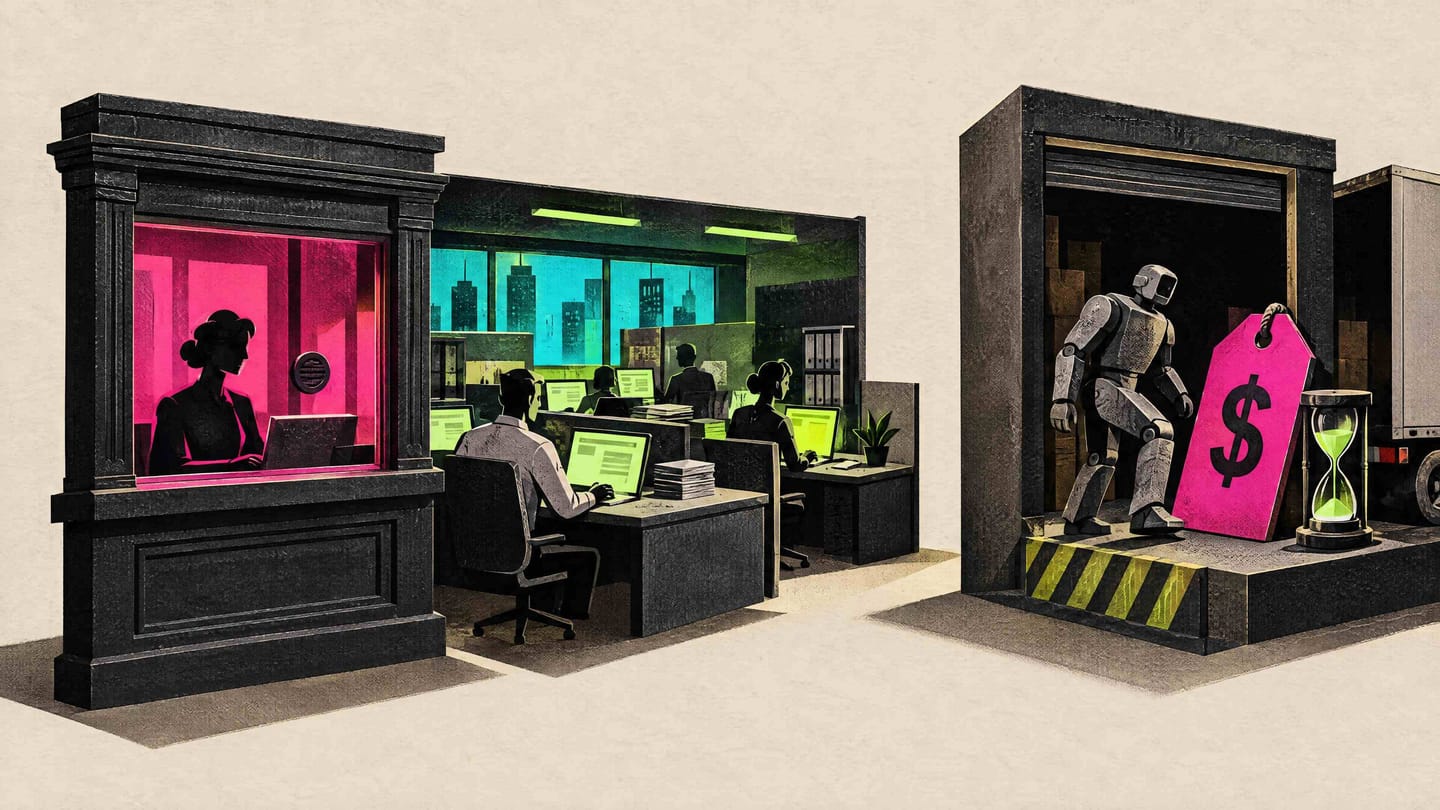
Channel 404 · Night Shift intercept
INCIDENT / FIELD REPORT / HUMAN EYES OPEN
The machine has entered the chat.
Original ANALTHROPIC visual nonsense for a serious problem. The reporting begins directly below; the neon is here to make the danger easier to spot.
FICTIONAL BROADCAST GRAPHICS NOT A PRODUCT DEMO

Technology analysis with satire // SOURCED REPORTING
Anthropic says a major bank is scaling Claude across code, knowledge search, and 120,000 daily market emails—then, same week, its own research admits physical robots are cost-competitive on roughly 0.3% of job tasks.
FICTION — internal efficiency notice, not a Barclays document:
From: Global Productivity Enablement
Subject: Welcome your new colleague (it does not need dental)
Effective immediately, knowledge work will be modernized. Software will be accelerated. Legacy systems will be gently threatened. Emails will be classified before they finish being annoying. Please direct gratitude to the model and complaints to a human who still has a calendar.
That is the vibe of today’s real announcement: Anthropic says Barclays is expanding Claude across bank operations while the same company, a day earlier, published research showing robots can already do a shocking share of physical tasks—and still almost never beat human labor on cost. The takeover did not start with a bipedal unit on the loading dock. It started with search boxes, ticket queues, and developer tooling that fits neatly inside a subscription and a governance slide.
On October 1, 2026, Anthropic announced an expanded Barclays collaboration to put Claude into software development, legacy modernization, and operations, citing large internal assistant and email-routing figures plus attributed goals for Claude Code adoption. On September 30 it published robot-exposure research arguing robots can perform many physical tasks but are cost-competitive on only about 0.3% of job tasks today.
ANALTHROPIC’S
DAILY TOP 5:
HOW NOT TO GET
FUCKED BY AI
Translate ‘50% of developers’ into three nouns you can audit
Employees and contractors hearing bank or vendor AI targets secondhand Write the claim as: which tool (e.g., Claude Code), which population definition counts as a ‘developer,’ and what ‘adoption’ means—login, weekly active use, or mandatory default. Ask your manager or vendor contact for those three nouns in writing; keep the reply next to any slide that only shows a percentage. Partnership posts love round adoption goals. Your workload changes based on definitions, not keynote arithmetic. [S1] You have a dated note with tool name, population definition, and adoption metric—or an explicit ‘unknown’ for each. This does not reveal confidential headcount and is not permission to scrape internal HR systems. [S1]
Make the knowledge assistant prove it before it becomes folklore
Office workers offered an internal AI search buddy Pick five real questions you already answer from approved manuals or intranet pages. Run them through the assistant if you have legitimate access, save answers beside the official source links, and flag any missing citation, stale policy, or customer-impacting invention before you reuse the text. Anthropic attributes large Barclays search volume to a Colleague Knowledge Assistant; volume is not the same as correctness on your desk. [S1] A short scorecard exists: five prompts, source match yes/no, and whether you would send the answer externally. Do not paste regulated customer data, credentials, or confidential deal terms into any assistant your policy forbids. [S1]
If AI touches your client email flow, demand the human handoff map
Freelancers supporting finance, ops, or inbox-heavy clients Before you rely on a client’s ‘AI classifies our mail’ story, email them three questions: what the model routes versus drafts, who approves external sends, and where misroutes are logged. Refuse to treat auto-routing as completed client communication until a named human path is written down. High-volume email classification is part of the Barclays narrative Anthropic published; your reputation still dies on the misrouted thread. [S1] You have a one-page handoff map or a written client refusal to provide one—either way your process is explicit. Proposal for your contracts; not legal advice and not a claim about Barclays’ private controls. [S1]
Stop letting robot demos set your hiring panic clock
Small business owners weighing automation hype against payroll When a pitch says robots ‘can already do’ a huge share of physical tasks, rewrite it using Anthropic’s own framing: task coverage versus cost-competitive share (0.3% today in their research) versus your actual floor layout, safety rules, and maintenance budget. Require a priced pilot on one bounded task before any headcount plan assumes replacement. Capability percentages without cost parity inflate urgency. Anthropic’s paper separates what robots can do from what undercuts human labor now. [S2] Your notes show three lines—task coverage claim, cost-competitiveness claim, pilot price—for any automation vendor meeting this month. Research estimates are not a forecast for your site; local regulation and insurance still rule. [S2]
Split your ‘exposed to AI’ list into screen work vs body work
Technical leads and ops coordinators planning 12-month tooling On one page, list roles by time on language/code/search tasks versus structured physical tasks. For screen-heavy roles, define evaluation prompts, access scopes, and human approval gates before widening assistants. For physical roles, track cost, environment constraints, and dexterity limits instead of copying LLM rollout language. Anthropic estimates broad exposure to robots or LLMs by working time, but the barriers and timelines differ hard between software seats and robots. [S1] [S2] The one-pager exists, with different success metrics for assistant pilots versus any robotics trial. Do not implement production bank controls you do not own; escalate changes to authorized administrators. [S1] [S2]
OKAY, HERE’S THE ACTUAL SHIT
OKAY, HERE'S THE ACTUAL SHIT.
Anthropic’s October 1 partner post says Barclays is expanding a strategic collaboration to integrate Claude across global operations for software development, legacy modernization, and operational efficiency. In that same narrative, Anthropic attributes to Barclays an expectation that Claude Code adoption will reach 50% of its developer population by the end of 2026 and a majority of software engineers in 2027. Those percentages are attributed expectations inside a vendor announcement, not an independent headcount audit. [S1]
Anthropic also says a Claude-powered Colleague Knowledge Assistant has been live since 2025, that more than 16,000 colleagues have adopted it, and that it has handled over one million searches for Barclays UK retail support. It says Global Markets teams use Claude to classify and route roughly 120,000 emails each day, and that Barclays applies governance, security controls, and human oversight to AI use cases. Treat every operational metric and oversight claim as Anthropic’s attributed deployment story unless your own contract team verifies it. [S1]
A day earlier, on September 30, 2026, Anthropic published robot-exposure research. It says robots can already perform about three-quarters of physical tasks in the US, amounting to 34% of working hours, mostly in limited settings. It also says robots are cost-competitive for just 0.3% of job tasks today, and that if robot price declines follow past trends it would take about 40 years for that share to reach 10%. [S2]
The same paper says workers more exposed to robots are more likely to be male, less educated, and lower paid, with barriers including structured-environment needs, cost, dexterity limits, preferences, and regulation. It estimates about 80% of job tasks by working time are exposed to either robots or LLMs, with remaining unexposed work highly interpersonal or requiring physical skills robots still lack. This is Anthropic research based on task ratings and public sources, not a measurement of Barclays’ rollout outcomes. [S2]
WHY AN ACTUAL HUMAN SHOULD CARE
WHY AN ACTUAL HUMAN SHOULD CARE.
If you write code, answer internal search questions, or live downstream of a markets inbox, the near-term story is not a sci-fi warehouse empty of humans. It is a bank-shaped proof that enterprise buyers will pay to put language models inside developer workflows, knowledge bases, and high-volume classification jobs—the work that already lives on screens and tickets. [S1]
Observation: the economics land first where the product is a seat, an API call, and a compliance paragraph. Analysis: Anthropic’s own robot paper is a cold shower on the opposite fantasy—that physical automation is equally “ready” just because task coverage sounds high. Capability without cost parity is a demo, not a mass replacement schedule. [S2]
Hypothetical example, clearly labeled: imagine two reorganizations in the same quarter. Team A gets a knowledge assistant and code-assist targets. Team B gets a slide about future robots and a hiring freeze “pending automation.” Only one of those has a dated vendor narrative with live search and email figures behind it. The other is still arguing with gravity, grippers, and price curves. [S1] [S2]
Real benefits can exist: faster internal search, less dumb email triage, help modernizing crusty systems—if humans still own exceptions, customer outcomes, and the blast radius when the model is confidently wrong. The satire writes itself when the same corporate family sells coding copilots at bank scale and, almost simultaneously, admits the robot that could theoretically do the heavy lift still loses the cost fight on 99.7% of tasks.
WHAT WE DON’T KNOW
WHAT WE DON'T KNOW.
We do not have independent verification of Barclays’ 16,000-adopter figure, the million-search total, the 120,000 daily emails, or whether Claude Code will actually hit 50% developer adoption by year-end 2026. Those are Anthropic-attributed partnership claims. [S1]
We do not know how often human oversight catches harmful errors, what data classes are excluded, or what “legacy modernization” means in production risk terms. Governance is described, not audited here. [S1]
On robots, we do not know whether Anthropic’s task-rating method overstates real-world performance outside structured settings, or how fast prices, regulation, and dexterity will actually move. The 40-year path to 10% cost-competitive share is a conditional research scenario, not a calendar appointment. The paper also does not measure this bank deployment. [S2]
SATIRE: HUMANITY SUPPORT
Issue: Human unit reports unequal replacement schedules: inbox already unionized by a model; warehouse robot still arguing with the price tag.
Response: Thank you for contacting Humanity Support. Ticket filed under Mixed-Fleet Envy. Diagnosis: language models fit inside existing laptops, VPNs, and governance PDFs; bipedal cost curves do not. Temporary workaround: continue labeling vendor adoption forecasts as forecasts and physical automation slides as conditional research. A specialist (you) must still approve money movement, customer harm, and anything that weighs more than a token.
Status: SATIRE — fictional Humanity Support ticket — Closed-Open (human remains on-call)
The bank story is about seats, searches, source code, and email firehoses. The robot story is about how long price, dexterity, and messy rooms can stall a fantasy that photographs better than it procures. Read both with the same adult habit: attribute the vendor, pocket the useful tool, and refuse to let a percentage do your management job. AI can reorganize the queue. Somebody human still owns the consequence when the queue is wrong.