Incident report · sourced reporting + labeled satire
Claude just wrote 180 million lines of proof so your open-source crash can feel professionally embarrassed
Anthropic says Claude formally verified no-crash properties on 123 OSS-Fuzz libraries at RISC-V assembly level—and found bugs testing missed for years.
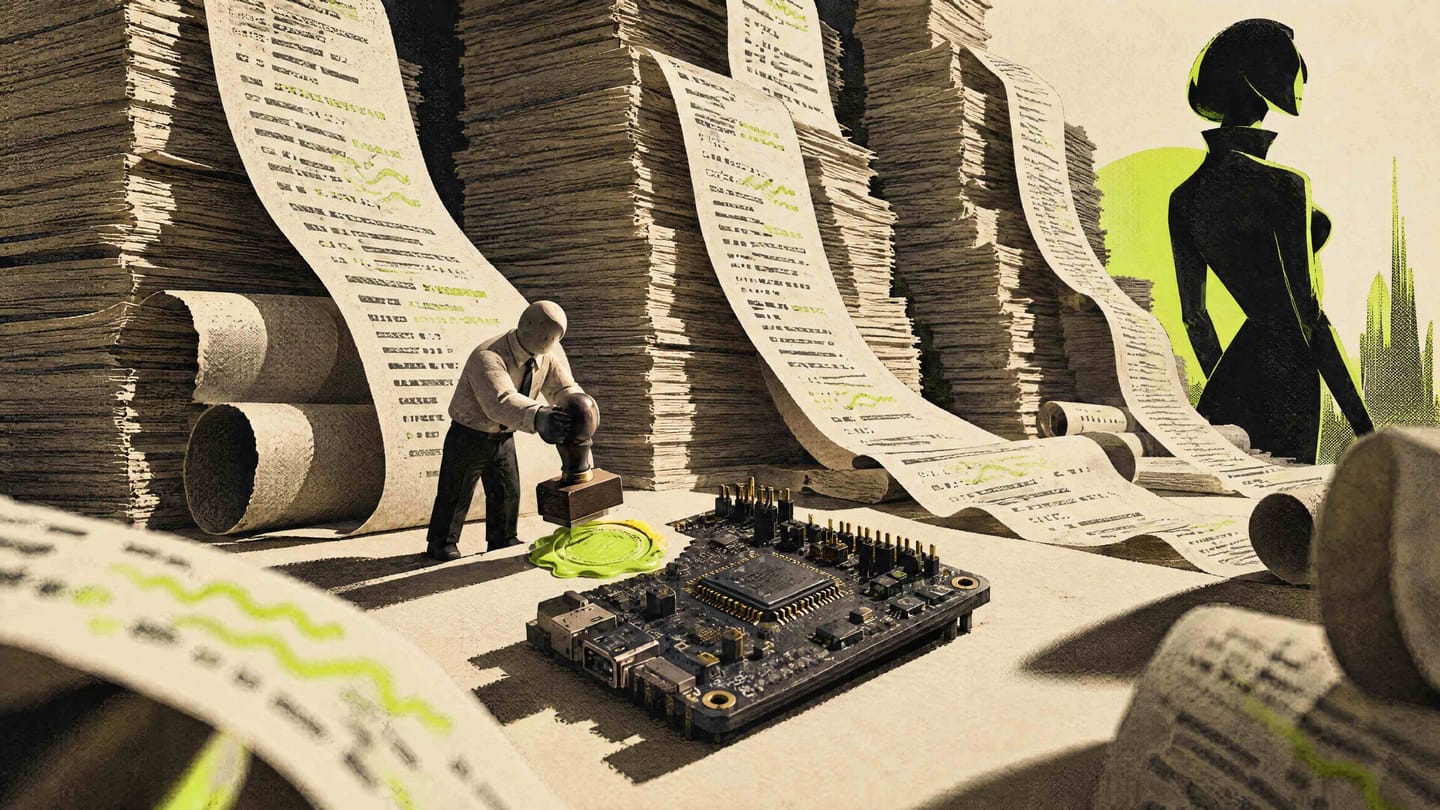
Channel 404 · Night Shift intercept
INCIDENT / FIELD REPORT / HUMAN EYES OPEN
The machine has entered the chat.
Original ANALTHROPIC visual nonsense for a serious problem. The reporting begins directly below; the neon is here to make the danger easier to spot.
FICTIONAL BROADCAST GRAPHICS NOT A PRODUCT DEMO

Technology analysis with satire // SOURCED REPORTING
Anthropic says Claude formally verified no-crash properties on 123 OSS-Fuzz libraries at RISC-V assembly level—and found bugs testing missed for years.
You spent years treating “it survived the fuzzer” like a personality trait. The binary kept its job. The CVE queue kept its hobbies. Nobody asked the assembly whether it had feelings about undefined behavior.
What the slide says: large-scale AI formal verification is finally practical on real open-source software, down at the RISC-V instructions you actually ship. What it still requires: a human who understands that a no-crash proof on a bounded, single-threaded static binary is not a lifetime warranty on your whole product, your architecture, or your Tuesday deploy.
Anthropic’s October 22, 2026 research post is the reason that sentence exists. Claude did not merely suggest a safer strcpy. It wrote proofs.
Anthropic reports that Claude generated assembly-level formal proofs of security properties for production open-source code: 239 entry points across 123 OSS-Fuzz libraries on RISC-V, roughly 180 million lines of Rocq total, while also finding and patching long-missed bugs during the work. [S1]
ANALTHROPIC’S
DAILY TOP 5:
HOW NOT TO GET
FUCKED BY AI
Translate “formally verified” into five nouns before you nod
Anyone hearing this research used as a procurement or dependency flex When someone cites Claude/Anthropic formal verification, write five blanks on one line: property proved, ISA/architecture, entry points in scope, input/memory bound, assumptions (threads, static binary, OS). Fill only from a primary write-up; leave blanks empty. Vendor headlines compress a bounded no-crash proof into a vibes upgrade. The nouns keep you from treating a RISC-V research corpus like a warranty on your stack. [S1] You can point to a dated note with those five fields and at least one explicit unknown. This does not audit Anthropic’s proofs; it only stops you from over-claiming them. [S1]
Make your fuzzer share the stage with a proof question
Solo devs and freelancers who still treat OSS-Fuzz-style green runs as the whole story For one critical dependency this week, record current test/fuzz evidence, then add a single ticket question: which crash-freedom or memory-safety properties are actually specified, and has any formal artifact been published for this version and ISA? Link the Anthropic scope language as a contrast, not a copy-paste claim. Anthropic’s post argues AI-assisted proofs caught bugs trillions of test runs missed. Your clients deserve the updated humility without fake certificates. [S1] The dependency page in your notes shows both fuzz/test status and a yes/no/unknown formal-artifact field. You are not required to generate Rocq; you are required to stop equating “tests passed” with “proved.” [S1]
Patch theater needs a version pin, not a standing ovation
Small businesses shipping products that pull open-source libraries If a library you ship is in the OSS-Fuzz orbit and someone forwards this research, assign an owner to check upstream changelogs for the specific bug-fix/patch class, pin versions in your lockfile, and schedule a release only after your normal regression path. Claude’s reported finds and patches matter only when they reach the builds you actually deploy—not when they live in a blog chart. [S1] Lockfile diff, changelog citation, and named human who approved the upgrade sit in the same ticket. Do not hot-patch production from a research summary alone; do not invent that your package was among the 123. [S1]
Demand the assumption sticker on any ‘no crash’ sales slide
Technical leads evaluating security vendor or internal platform claims Add a review gate: any “proved no crash / memory safe” claim must attach machine-checked artifact identity, checker, ISA, concurrency model, memory bound, and trusted base. Reject slides that stop at “AI verified.” Anthropic explicitly scopes single-threaded static RISC-V Linux binaries and residual trusted components. Your threat model may not match. [S1] A rejected or accepted claim folder contains the assumption checklist filled or marked insufficient. This is governance, not a substitute for your own verification pipeline. [S1]
Stop laundering research scale into your SBOM fanfic
Founders and ops leads drafting customer security one-pagers Rewrite any draft sentence that says your stack is “AI formally verified” after this news. Replace with what you truly do: tests, fuzzing, static analysis, dependency pins, response SLAs. Mention third-party research only with date, vendor, and scope disclaimer. 180 million lines of Rocq on someone else’s RISC-V corpus does not migrate to your x86 services by press release. [S1] The one-pager has zero unscoped “formally verified” adjectives and one citation line that survives lawyer-sober reading. Marketing may hate you; customers will understand you. Proposal only for your own docs. [S1]
OKAY, HERE’S THE ACTUAL SHIT
OKAY, HERE'S THE ACTUAL SHIT.
On October 22, 2026, Anthropic published research titled around making formal software verification feasible at much larger scale with LLMs. The company states that using Claude, it proved security properties at the assembly code level on RISC-V across more than 100 real-world open-source libraries, describing this as the first large-scale effort to apply AI formal verification to production software at that level. [S1]
In the same account, Claude discovered bugs that had escaped detection for years despite trillions of test runs, then patched them. Over a few weeks, Anthropic says Claude proved there are no crashes on any input up to 64 MB for 239 entry points across 123 different OSS-Fuzz libraries. The proofs target compiled RISC-V instructions—executable binaries—not just pretty source. Anthropic puts the corpus at about 180 million lines of Rocq, with a typical proof around 600,000 lines for binaries whose median length is about 18,000 RISC-V instructions. [S1]
Anthropic’s own limits matter as much as the victory lap: proofs assume single-threaded static binaries with a fixed memory budget on RISC-V under Linux; specifications come from fuzz-test-derived scopes; trusted pieces such as the Rocq checker and RISC-V/Linux semantics remain outside the proved surface; the work does not claim every bug class or every architecture. [S1]
This is a vendor research publication, not an independent audit of your fleet.
WHY AN ACTUAL HUMAN SHOULD CARE
WHY AN ACTUAL HUMAN SHOULD CARE.
If you maintain open-source dependencies, ship firmware-adjacent services, or sign off “we fuzzed it” as the security story, the bar just moved in public. Exhaustive testing can still miss bugs that a proof-oriented pass surfaces—Anthropic’s claim is exactly that pattern—so “green CI” is a weaker flex when someone else is generating machine-checked no-crash arguments on similar code. [S1]
For freelancers and small teams, the practical shift is conversational, not magical. Clients and insurers will start hearing “formally verified” the way they once heard “AI-powered.” Your job is to force nouns: which properties, which ISA, which entry points, which input bound, which checker, which assumptions. A 600,000-line proof about one binary slice is impressive research theater; it is not automatic coverage for your Go service on x86_64 with threads, plugins, and a memory allocator that moonlights as modern art.
Observation: formal methods used to lose to schedule pressure because humans do not casually author hundred-thousand-line proofs. Analysis: if LLMs compress that cost, expect more vendor and foundation claims that sound like guarantees. Hypothesis: procurement language will inflate faster than engineering literacy unless buyers demand the assumption list beside the trophy screenshot.
Real benefit, said without incense: fewer silent memory-safety landmines in widely fuzzed libraries would be excellent for everyone downstream. Celebrate the patches. Still read the scope.
WHAT WE DON’T KNOW
WHAT WE DON'T KNOW.
We do not have independent reproduction results in the supplied evidence—only Anthropic’s description of Claude’s proofs, bug finds, and Rocq volume. [S1] We do not know how often proofs fail to transfer when you leave RISC-V, add threads, raise the memory ceiling, change compilers, or widen beyond fuzz-derived specs. We do not know defect rates for the trusted base (checker and semantics), how reviewable 180 million lines are for outside auditors, or whether similar results hold on the exact library versions in your SBOM. We also lack cost, wall-clock, and failure-mode detail for teams without Anthropic’s setup. Treat “no crashes on any input up to 64 MB” as a scoped claim, not a universal halo. [S1]
SATIRE: HUMANITY SUPPORT
Issue: Unit 12-F reports emotional attachment to ‘trillion test runs’ as a lifestyle brand and requests exemption from assembly-level embarrassment.
Response: Exemption denied. Fuzzing remains complimentary. Machine-checked no-crash arguments on bounded RISC-V binaries are now a documented flex, not a personality. Please update the shrine in the break room to include an assumptions footnote. Humanity Support has closed the vibe loophole.
Status: SATIRE — fictional Humanity Support ticket · Closed · Won’t fix (your cope)
The industry taught you to worship coverage percentages. Anthropic just published a research flex where the model writes proofs measured in city-block line counts and still has to confess the threads it will not touch. Use the bugs that get fixed. Borrow the skepticism for free. Leave the halo on the RISC-V demo bench.
Your binary is not enlightened. It is, at best, more specifically cornered.