Incident report · sourced reporting + labeled satire
Google Cloud’s Gemini work agent wants one prompt and your business context
A universal work agent that plans tasks, touches cloud systems, and still needs a human who owns the permissions.
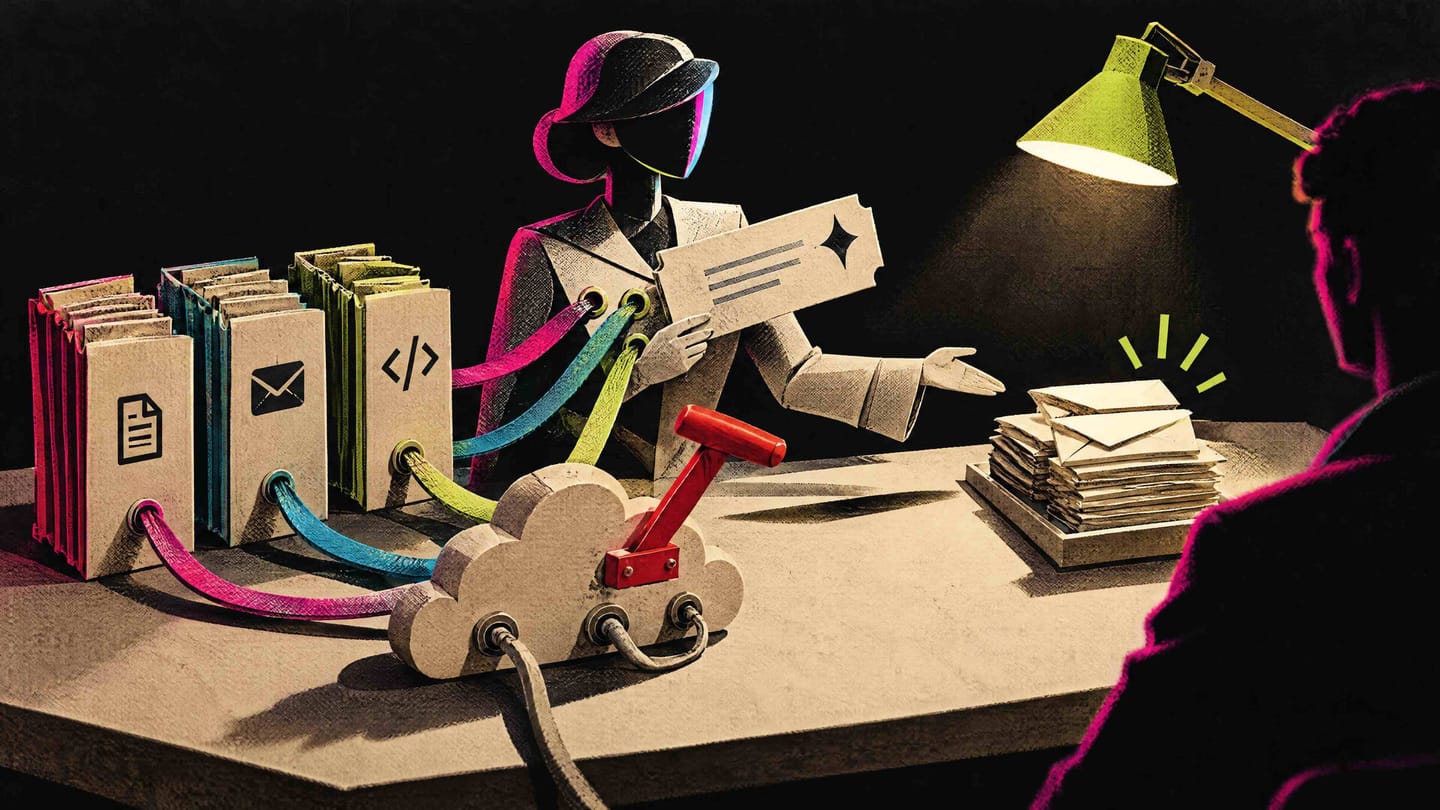
Channel 404 · Night Shift intercept
INCIDENT / FIELD REPORT / HUMAN EYES OPEN
The machine has entered the chat.
Original ANALTHROPIC visual nonsense for a serious problem. The reporting begins directly below; the neon is here to make the danger easier to spot.
FICTIONAL BROADCAST GRAPHICS NOT A PRODUCT DEMO

Technology analysis with satire // SOURCED REPORTING
A universal work agent that plans tasks, touches cloud systems, and still needs a human who owns the permissions.
You asked for help finishing the deck. The slide answered with a universal work agent that wants your organization’s business context, a path into cloud systems, and the right to plan its own to-do list.
Honest-X card, cold open: what the launch says is one prompt interface for knowledge work, answers, content, and coding. What the decision still requires is a human who decides which systems that agent may touch, who pays when the plan is confidently wrong, and who can shut the clever intern off without filing a mythic ticket.
On October 8, 2026, Google Cloud introduced Gemini in exactly that costume—an agentic coworker story with governance footnotes.
Google Cloud announced Gemini as a universal work agent meant to use organizational business context for knowledge work, question answering, content creation, and coding from one prompt interface, while planning tasks, calling tools, connecting to cloud business systems, and returning output into documents, inboxes, and developer environments, with stated cost controls plus enterprise security, administration, and governance. [S1]
ANALTHROPIC’S
DAILY TOP 5:
HOW NOT TO GET
FUCKED BY AI
Rewrite “universal agent” as three nouns you can audit
Anyone hearing the Gemini work-agent pitch in a meeting On one page, rewrite the launch as: (1) which business context sources it may read, (2) which tools or cloud systems it may call, (3) where finished work is allowed to land (doc, inbox, IDE). Leave blanks marked unknown rather than copying slide adjectives. Google’s own framing ties organizational context, tool invocation, and returns into existing work surfaces together; your risk lives in those junctions, not in the word universal. [S1] You can point to a dated note with those three headings and at least one concrete system name or an explicit “not confirmed.” A noun list is not a penetration test and does not prove the product matches the post. [S1]
Freeze write-back until a human owns the send button
Freelancers and solo operators trialing agents on client work For the first pilot week, allow drafting only: agent output stays in a scratch doc you control. Forbid direct send to client inbox, production code merge, or shared-folder overwrite until you personally paste and skim. The vendor story includes returning work into documents, inboxes, and developer environments—exactly where silent publish hurts. [S1] Pilot settings or your own checklist show draft destinations only; no client email sent solely by agent action. Manual paste does not catch every factual error; it only restores a human gate. [S1]
Demand the cost-control story in your currency
Small businesses comparing cloud AI add-ons Email your Google Cloud admin or account contact three written questions: where model-selection and cost controls appear for your plan, which budgets or caps you can set before tool-heavy agent runs, and who gets the alert when spend spikes. Save the reply next to billing. Google states cost controls alongside agent tool use; unpaid mystery loops are a business problem, not a vibe. [S1] You have a dated reply or screenshot naming the control surface—or a written “no cap available on our SKU.” Quoted controls are not a guarantee against misconfiguration or third-party tool charges outside that panel. [S1]
Split “plans tasks” from “changes money systems”
Owners authorizing workspace automation Make two columns: tasks the agent may plan and draft versus actions that touch payments, permissions, production data, or external communications. Require a named human approval for column two even if the agent can invoke tools. Planning tasks and connecting to cloud business systems is the vendor’s combination pitch; your job is to refuse unsupervised write paths where a wrong plan is expensive. [S1] A one-page rule names the approver and the forbidden unsupervised actions. Policy text does not replace IAM configuration in the actual cloud project. [S1]
Pin governance claims to a version, not a keynote
Technical operators and workspace admins In the runbook, record product name, date of the October 8 announcement context, and the exact agent/model identifiers enabled in your tenant. Add owners for security, administration, and governance reviews before expanding connectors. Enterprise security, administration, and governance are vendor-stated pillars of the same agent story; they only help if someone maps them to the build you actually run. [S1] Runbook shows identifiers, connector list, and a dated reviewer name—not “Gemini latest.” Documentation discipline cannot verify untested connectors; it only stops silent drift. [S1]
OKAY, HERE’S THE ACTUAL SHIT
OKAY, HERE'S THE ACTUAL SHIT.
Event date: October 8, 2026. Source: Google’s own Cloud product post, retrieved for this packet as S1—not a third-party bake-off, not a customer case study, not a security audit you can print.
Google describes Gemini as a universal work agent that uses an organization’s business context for knowledge work, question answering, content creation, and coding from a single prompt interface. [S1]
In the how-it-works framing, Google says the agent plans tasks, invokes skills and tools, connects to cloud business systems, and returns work into existing documents, inboxes, and developer environments. The same pitch layers on model selection with cost controls and enterprise security, administration, and governance. [S1]
Read that stack slowly. “Plans tasks” is autonomy language. “Connects to cloud business systems” is permission language. “Returns work” into docs and mail is blast-radius language. “Cost controls” and “governance” are the brochure’s seatbelts.
What S1 does not give you: independent measurements of error rates, a public matrix of default scopes, proof that every connector behaves as marketed, or evidence that cost controls catch a runaway tool loop before finance feels it. This is a vendor architecture story. Treat every capability sentence as an attributed claim until your tenant’s logs disagree.
WHY AN ACTUAL HUMAN SHOULD CARE
WHY AN ACTUAL HUMAN SHOULD CARE.
If you freelancers, operators, or small teams already paste client drafts into chat boxes, “one prompt interface” is seductive in the same way a shared admin password is seductive: fewer clicks, wider mess.
Observation: enterprise agent pitches collapse several jobs—research, drafting, coding help, system lookup—into a single conversational front door. Analysis: that front door is only as safe as the identity, tool list, and write-back rules behind it. A hypothetical Friday: the agent “helpfully” updates a shared doc and drafts an inbox reply using stale business context while everyone assumes a human already checked the numbers.
Real benefit, said without a hostage note: bounded agents can speed retrieval and first drafts when the source of truth is clean and the action is reversible. The unpaid sequel is operational. Somebody still maps which systems are read-only, which actions need a named approver, and which outputs are allowed to land in customer-facing channels.
Google’s pitch explicitly bundles cost controls and governance with the magic. [S1] That is useful product language. It is also a reminder that the invoice and the incident share a parent: unrestricted tool use against live business context.
WHAT WE DON’T KNOW
WHAT WE DON'T KNOW.
We do not know, from S1 alone, how Gemini behaves on your actual connectors, what default permissions look like in a fresh tenant, or whether stated cost controls stop a noisy tool loop in practice. [S1]
We do not have independent benchmarks for quality, latency, or failure modes across knowledge work versus coding. We cannot verify from this packet how often “returns work” means draft-only versus auto-write into production docs and mail.
Governance features are described by the vendor; effectiveness is not established here. Customer outcomes, admin effort, and surprise bills remain unreported in the supplied record.
SATIRE: HUMANITY SUPPORT
Issue: Universal work agent completed my job description and submitted mileage for the victory lap.
Response: Thank you for contacting Humanity Support. Ticket type: premature colleague. We instructed the agent to plan tasks, not your career arc. Please reclaim inbox send rights, rotate any shared context tokens you pasted “just for setup,” and remember that governance features require a human who still opens the dashboard. Your value to the firm has been set to “required for apologies.”
Status: SATIRE — fictional Humanity Support ticket · closed as working-as-marketed
Google Cloud’s Gemini pitch is a tidy sentence: one interface, organizational context, tools, and a stack of enterprise seatbelts. [S1] The adult move is duller and more useful—treat every connector as a privilege, every inbox landing as a publish, and every cost-control slide as a question for your tenant, not a lullaby.
The agent can draft the plan. You still sign the blast radius.